UAS DATALINK
SOLUTIONS
OFF THE SHELF AND
READY TO INTEGRATE
Persistent Systems offers ready-to-integrate solutions to provide reliable connectivity, bidirectional video transmission, and edge computing power for UAS platforms of all sizes in congested and contested RF environments.
Shield AI V-BAT shown

UAS DATALINK SOLUTION
Wave Relay® Device
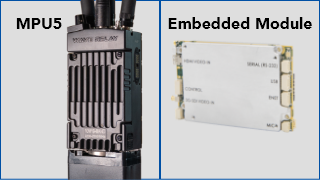
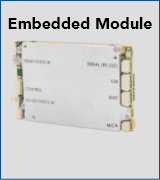
RF Module
Antennas
LONG RANGE
POWERFUL RF TECHNOLOGY
With up to 10W of transmit power and 3x3 MIMO
technology, Wave Relay devices reliably transmit
data farther and faster.
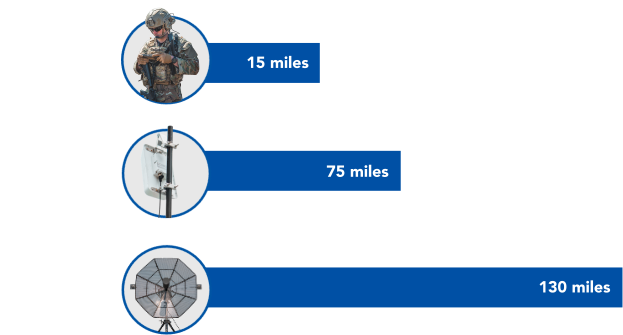
A: Installing three antennas is recommended because it provides the highest performance by improving connectivity when banking, extending range because of the additional power (up to 10W with 3 antennas), and increasing polarization diversity at the reciever/ground control station.
A: Some antennas require ground planes when installed. See the Tech Support Portal for more information.
SPECTRUM Availability
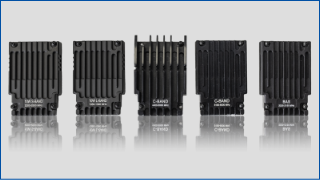
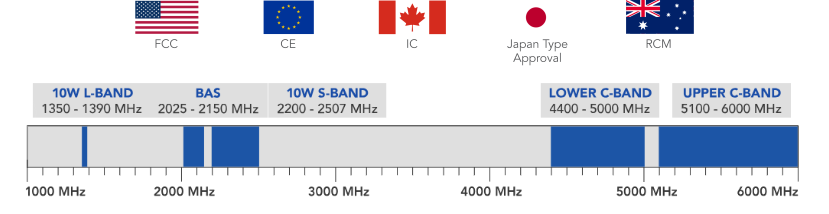
Persistent’s RF Modules are available in L-, S-, and C-Band and interchangeable, allowing you to design one
product for any country or industry as well as future-proof your platform as spectrum regulations evolve.
COMMUNICATE IN CONGESTED & CONTESTED ENVIRONMENTS
WAVE RELAY INTERFERENCE RESILIENCE & DEFENSE (IRD)
Wave Relay IRD is a U.S. Department of Defense-assessed, firmware based solution that protects the Wave Relay® network from interference – both intentional and unintentional – without reducing performance and scalability. Wave Relay IRD is an always-on capability – no configuration required. Upgrading your firmware to the most recent version allows you to future-proof your network with an updated library of countermeasures.
A: Yes. EW survivability test reports from both the US Army Combat Capabilities Development Command (DEVCOM) and Ukrainian Government are available via SIPRnet. To request a report, please contact security-certifications@persistentsystems.com
IMPROVE UAS FLIGHT TIME
REDUCED SWaP SOLUTION
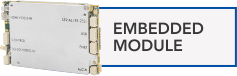
Persistent’s solutions unite your UAS platform’s communication, computing, and video subsystems into a single, low-SWaP form factor. Replace separate and specialized equipment with a single Embedded Module that performs the same functions but takes up less space, weighs less, consumes less power, and costs fewer dollars and engineering hours to integrate. Leverage your SWaP savings to deliver what matters most: the mission, time on station, and the payloads your platform carries.

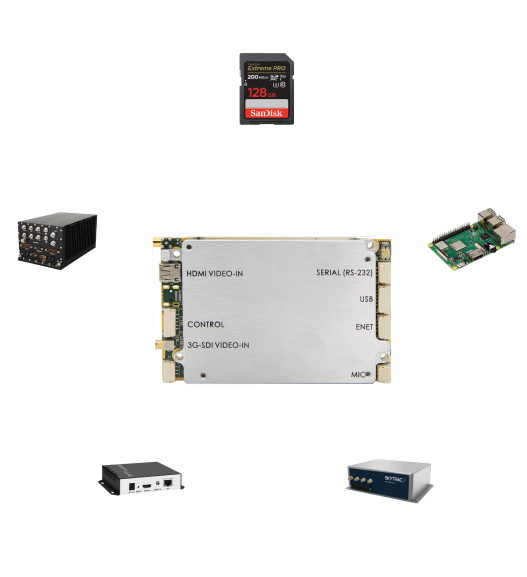
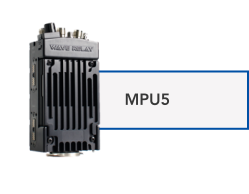
A: The Embedded Module or MPU5 acts as the communications link, video encoder, video link, onboard computing platform, and provides 128 GB of flash storage.
GLOBAL CONNECTIVITY

Fly your UAS platform from anywhere or backhaul video over SATCOM, Starlink, Cellular, or other Layer 3 transport. Cloud Relay™ provides seamless Ethernet connectivity to platforms located all over the world by any means necessary.
A: As more platforms are starting to integrate beyond line-of-sight capabilities, Cloud Relay automatically manages the transition between LOS and BLOS communication without gaps in connectivity. It’s a built-in automated PACE solution, available out-of-the-box to UAS manufacturers.
A: Adding Layer 3 transport to ground control stations allows you to place those ground control stations closer to the front line and place the control center farther away. This both increases communication performance by mitigating EW and improves safety.
STREAM HD VIDEO
ONBOARD VIDEO ENCODING
Your platform’s camera connects directly to the UAS datalink solution via 3G-SDI, NTSC, or HDMI. The Wave Relay device encodes video, embeds KLV metadata, and distributes the feed natively.

A: Yes. Wave Relay devices transmit video as a multicast stream so end users can decode and view it. Because the stream has embedded KLV metadata, ATAK can place points of interest on the map; users can see both the location of the aircraft as well as where the aircraft camera is looking.
A: By using the Wave Relay device’s integrated video encoder, you can remove a dedicated video encoder from your UAV design and reduce SWaP-C impact, resulting in longer flight time.
Transmit Knowledge
Instead of Data
ONBOARD COMPUTING
Our solutions offer an edge computing platform that runs Wave Relay OS, a custom, Android™-based operating system. Use the onboard computing capability to process sensor data at the source and transmit knowledge instead of a raw data stream. Run targeting, swarming, or other apps directly on the device to drive machine decisions without human input.
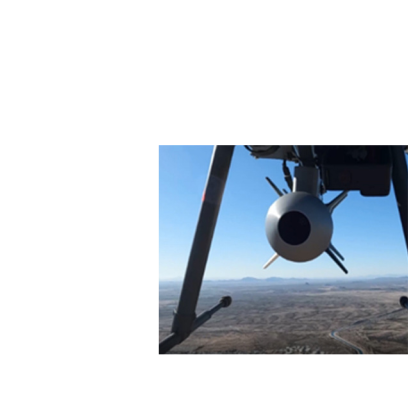
A: Integrators use the Wave Relay device’s onboard Android compute for autonomy, swarming, and airspace deconfliction. Third parties utilize the lightweight compute to send periodic coordination messages for their autonomy engines.
A: A lightweight alert monitors a CBRNe sensor onboard the UAS, and, if it alerts, sends a report to the ground control station and end users.
EASY TO INTEGRATE
FLEXIBLE INSTALLATION
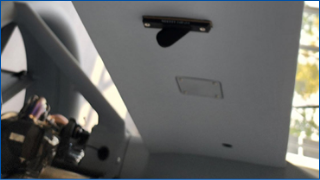
Multiple integration options allow you to fit the Persistent’s UAS datalink solutions into your design. CAD/STEP files are available to help design an external RF module mount for spectrum flexibility.
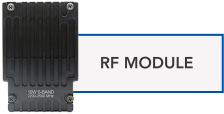
A: First, allowing access to the RF module allows users to swap bands easily. Second, different RF modules have different thermal considerations. Mounting them externally allows the RF module to be cooled by its heatsink being exposed to the air.
A: CAD/STEP files are included with the Embedded Module kit and are available on the Tech Support Portal.
Next

